

Commercial HVAC ductwork serves as the circulatory system of your building's climate control—the network that delivers conditioned air to every occupied space and returns it for reconditioning. Properly designed and installed ductwork ensures consistent comfort, optimal energy efficiency, and reliable operation for decades. Poorly designed or installed ducts waste 20-40% of conditioned air through leakage, create hot/cold spots, generate excessive noise, and force equipment to work harder than necessary. This comprehensive guide covers everything Houston building owners and facility managers need to know about commercial ductwork systems.
Licensed & Insured - TACLB00105442E - Commercial Duct Design & Installation Experts
Understanding Commercial Ductwork Fundamentals
Commercial ductwork differs significantly from residential systems in scale, complexity, and performance requirements. While a typical home might have 200-400 feet of ductwork, commercial buildings often contain thousands of feet spanning multiple floors and zones. Understanding the fundamental components helps building owners make informed decisions about design, installation, and maintenance.
Primary Duct System Components
Supply Ductwork: Delivers conditioned air from air handling units to occupied spaces. Supply ducts operate under positive pressure, meaning air pushes outward through any leaks. Proper sealing is critical to prevent wasted energy and ensure adequate delivery to all zones.
Return Ductwork: Collects air from occupied spaces and routes it back to air handlers for reconditioning. Return ducts operate under negative pressure, drawing air inward through any openings. Leaky return ducts in unconditioned spaces (attics, mechanical rooms) can draw in hot, humid air that increases cooling loads.
Exhaust Ductwork: Removes contaminated air from restrooms, kitchens, laboratories, and other areas requiring dedicated exhaust. Exhaust ducts must be properly sized and routed to prevent cross-contamination and meet building codes.
Outside Air Ductwork: Brings fresh outdoor air into the HVAC system for ventilation. In Houston's climate, outside air represents a significant cooling and dehumidification load requiring careful management.
Duct Shapes and Configurations
Commercial Duct Materials Compared
Material selection impacts ductwork durability, performance, cost, and maintenance requirements. Each material has optimal applications where it excels.
Galvanized Steel
The industry standard for commercial HVAC ductwork. Galvanized steel offers exceptional durability, fire resistance, and longevity—properly installed galvanized ducts can last 25-30 years or more with minimal maintenance.
Specifications:
- Gauge: 26-gauge for small ducts, 24-gauge for medium, 22-gauge for large ducts
- Coating: G90 galvanizing (0.9 oz zinc per sq ft) standard for HVAC
- Joining: Pittsburgh lock, TDC/TDF flanges, or welded connections
- Sealing: Mastic or tape at all joints and seams
Cost range: $8-$20 per linear foot installed (rectangular), $6-$15 (spiral round)
Aluminum
Lighter than steel with natural corrosion resistance. Often used in specialty applications like commercial kitchens, outdoor installations, or where weight is a concern. Higher material cost than galvanized steel limits general use.
Best for: Corrosive environments, outdoor installations, grease ducts, weight-sensitive applications
Stainless Steel
Premium material for demanding environments. Required by code for commercial kitchen exhaust hoods and used in laboratories, clean rooms, and food processing facilities. Significantly more expensive than galvanized steel but offers superior corrosion resistance and cleanability.
Best for: Kitchen exhaust, laboratory fume hoods, pharmaceutical facilities, clean rooms
Fiberglass Duct Board
Rigid fiberglass panels with internal facing, providing built-in insulation and sound attenuation. Commonly used in office buildings and retail spaces where acoustic performance matters. Requires careful fabrication and sealing to prevent fiber release.
Advantages: Built-in insulation (R-4.2 to R-8), excellent sound attenuation, lower installation labor
Limitations: Susceptible to moisture damage, can harbor mold if exposed to water, limited pressure capability
Cost range: $4-$10 per square foot of duct surface area
Flexible Duct
Insulated flexible ducts work well for short final connections between rigid ductwork and supply diffusers. However, excessive flex duct creates high pressure drop, restricts airflow, and reduces system efficiency. ASHRAE and SMACNA guidelines limit flex duct runs to 5 feet maximum in commercial applications.
Acceptable uses: Final connections to diffusers, terminal unit connections
Avoid: Main duct runs, lengths over 5 feet, sharp bends
Duct Design Principles for Commercial Buildings
Proper duct design balances multiple factors: adequate airflow delivery, acceptable noise levels, reasonable pressure drop, practical installation, and cost efficiency. Commercial duct design requires engineering calculations and should be performed by qualified HVAC engineers or experienced contractors.
Design Approaches
Equal Friction Method: The most common commercial design approach. Duct sizes are selected to maintain constant pressure drop per unit length throughout the system. This provides balanced airflow distribution and predictable fan performance. Typical commercial systems design for 0.08-0.10 inches water column (in. w.c.) per 100 feet of duct.
Static Regain Method: More sophisticated approach that sizes ducts to regain static pressure at each branch, offsetting friction losses. Results in larger ducts near the fan and smaller at the extremities. Often used for long duct runs or critical air distribution systems.
Velocity Reduction Method: Simplest approach that progressively reduces duct velocity from main trunk to branches to terminals. Adequate for simple systems but may result in oversized ductwork.
Critical Design Considerations for Houston Buildings
Houston's climate creates specific ductwork design challenges:
- Condensation prevention: Supply ducts carrying cold air through hot, humid spaces (attics, rooftops) must have adequate insulation with vapor barriers to prevent condensation on duct exteriors
- Dehumidification: Duct systems must maintain low enough velocities at coils to ensure proper moisture removal
- Thermal loads: Ducts in unconditioned spaces gain significant heat; designs must account for this by increasing supply air volumes or improving insulation
- Hurricane considerations: Rooftop duct penetrations and exposed equipment must meet wind load requirements
Layout Best Practices
- Minimize duct length: Shorter runs reduce friction losses and installation costs
- Avoid abrupt direction changes: Use gradual elbows (radius 1.5x duct diameter) instead of sharp turns
- Provide access: Include access doors at fire dampers, VAV boxes, and cleaning points
- Account for expansion: Long duct runs need expansion joints to prevent buckling
- Balance branch takeoffs: Use proper fittings to ensure balanced airflow to all branches
- Locate diffusers properly: Position supply outlets to throw air across occupied zones without drafts
Duct Sizing and Airflow Calculations
Proper duct sizing ensures adequate airflow delivery while maintaining acceptable velocities, noise levels, and system pressure requirements. Undersized ducts restrict airflow and increase energy consumption; oversized ducts waste material and installation costs.
Velocity Guidelines for Commercial Ducts
CFM Calculation Basics
Airflow requirements (CFM - cubic feet per minute) derive from cooling/heating load calculations. General commercial guidelines:
- Office space: 1.0-1.5 CFM per square foot
- Retail: 1.5-2.5 CFM per square foot
- Restaurants (dining): 2.0-3.0 CFM per square foot
- Restaurants (kitchen): Exhaust hood requirements drive design
- Warehouses (conditioned): 0.5-1.0 CFM per square foot
- Computer rooms: Based on equipment heat load, often 3-5 CFM per square foot
Actual requirements depend on detailed load calculations accounting for occupancy, lighting, equipment, envelope performance, and Houston's specific climate conditions.
Duct Size Determination
Once CFM requirements and desired velocity are known, duct size is calculated:
Round duct area (sq ft) = CFM ÷ Velocity (FPM)
Round duct diameter (inches) = √(Area × 4 ÷ π) × 12
For rectangular ducts, the aspect ratio (width to height) should not exceed 4:1 to maintain efficient airflow. Higher aspect ratios increase friction loss and duct surface area (increasing insulation and material costs).
Commercial Ductwork Installation Best Practices
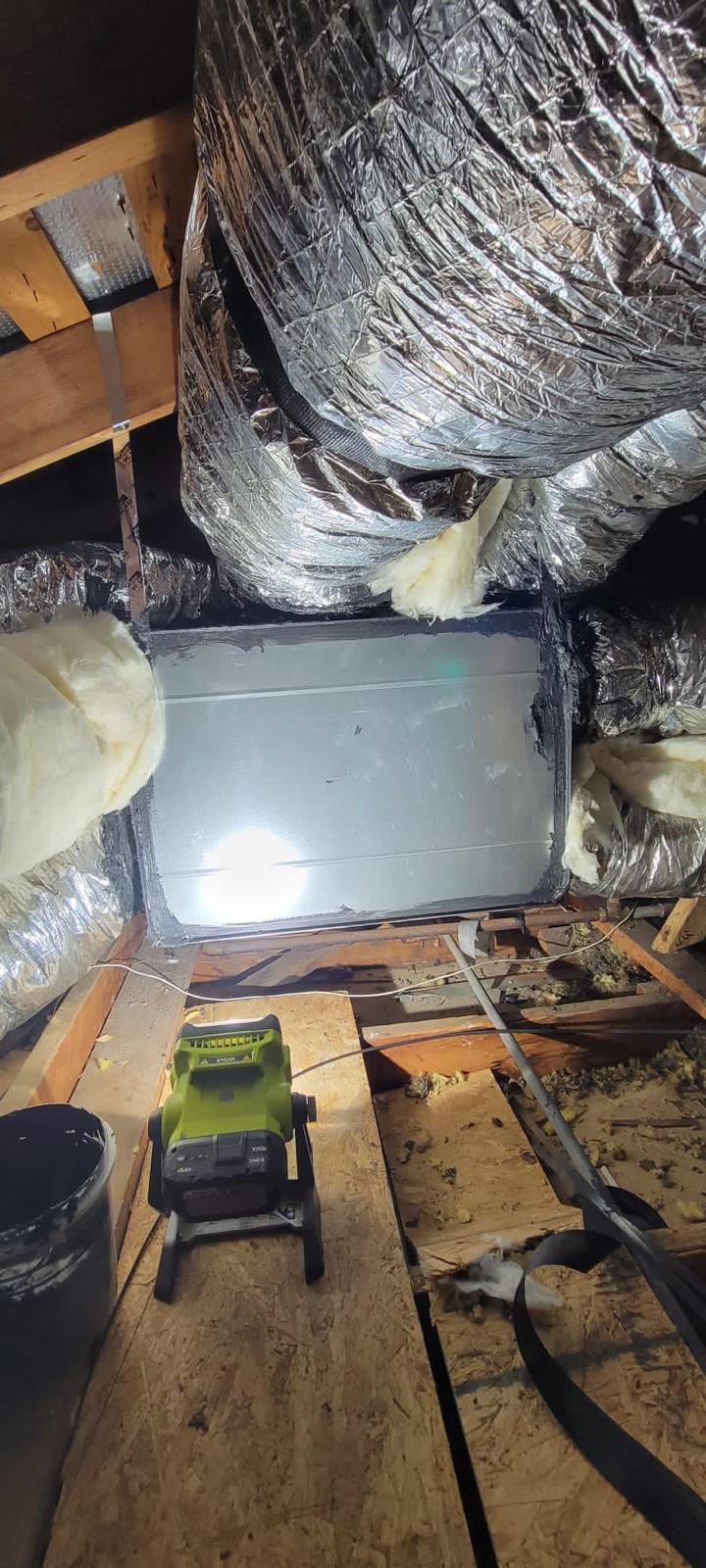
Quality installation determines whether ductwork performs as designed. Poor installation creates leakage, noise, unbalanced airflow, and premature failure regardless of design quality.
Joint Sealing Requirements
Commercial ductwork should achieve Seal Class A (all transverse joints, all longitudinal seams, and all connections sealed) per SMACNA standards. Acceptable sealing methods:
- Mastic: Water-based or solvent-based duct mastic applied with brush, trowel, or spray. Preferred for permanent installations. Apply minimum 1/8" thick with embedded fabric tape for joints over 1/4".
- Foil tape: UL 181A-P or 181B-FX rated metal tape for accessible joints. Ensure clean, dry surfaces and firm pressure during application.
- Gaskets: Neoprene or foam gaskets at flanged connections compress to create tight seals.
Avoid: Cloth duct tape fails within 1-2 years and does not meet commercial sealing requirements.
Hanger and Support Requirements
Proper support prevents duct sagging, joint separation, and vibration transmission:
- Horizontal ducts: Maximum 10-foot spacing for rectangular ducts, 12 feet for round spiral
- Vertical risers: Support at each floor plus mid-floor for runs over 6 feet
- Flexible duct: Support every 4 feet maximum to prevent sagging
- Hanger types: Trapeze hangers for rectangular, ring hangers for round, rod supports for heavy loads
- Isolation: Vibration isolators at air handler connections to prevent noise transmission
Fire and Smoke Dampers
Building codes require fire dampers where ducts penetrate fire-rated walls and floors, and smoke dampers where ducts penetrate smoke barriers. Proper installation ensures life safety during emergencies:
- Install dampers within manufacturer's specifications (typically within 24" of rated barrier)
- Provide access doors for inspection and testing
- Document damper locations for building records
- Test dampers upon installation and annually thereafter
Balancing Dampers
Manual balancing dampers in branch ducts enable airflow adjustment during commissioning. Opposed blade dampers provide better modulation than single blade designs. Mark damper positions after balancing for future reference.
Ductwork Insulation Requirements for Houston
Houston's hot, humid climate makes duct insulation critical for energy efficiency and condensation prevention. Texas Energy Code and ASHRAE 90.1 establish minimum requirements, but Houston conditions often warrant exceeding minimums.
Minimum Insulation Requirements
Vapor Barrier Considerations
In Houston's humid climate, vapor barriers are critical for insulated ducts in unconditioned spaces. Without proper vapor barriers, humid air condenses on cold duct surfaces beneath the insulation, causing:
- Insulation saturation and reduced R-value
- Mold growth within insulation
- Metal duct corrosion
- Ceiling damage from condensate dripping
Specify insulation with factory-applied vapor barriers (FSK - foil/scrim/kraft facing) and seal all joints and penetrations with vapor barrier tape or mastic.
Insulation Types
Fiberglass wrap: Most common for rectangular ducts. Available in various densities and thicknesses with FSK facing. Requires careful installation to maintain consistent thickness.
Fiberglass board: Rigid insulation for rectangular ducts requiring higher durability. More expensive than wrap but provides uniform coverage.
Elastomeric foam: Flexible closed-cell foam with inherent vapor barrier properties. Excellent for round ducts and areas prone to physical damage. Higher material cost offset by easier installation on complex shapes.
Spray-applied insulation: Polyurethane or fibrous spray creates seamless coverage on complex duct configurations. Eliminates joints and penetrations as condensation points.
Commercial Ductwork Costs and Project Timeline
Typical Cost Ranges for Houston Commercial Projects
Total Project Cost Estimates
For complete commercial ductwork systems including design, materials, installation, insulation, and commissioning:
- Small commercial (under 5,000 sq ft): $25,000 - $50,000
- Medium commercial (5,000-25,000 sq ft): $50,000 - $150,000
- Large commercial (25,000-100,000 sq ft): $150,000 - $500,000
- Multi-story office (100,000+ sq ft): $500,000 - $2,000,000+
These ranges assume new construction with open ceiling access. Retrofit projects in occupied buildings with finished ceilings typically cost 30-50% more due to access constraints and phased work requirements.
Project Timeline
Commercial ductwork installation timelines depend on building size, complexity, and access conditions:
- Small commercial (under 5,000 sq ft): 1-2 weeks
- Medium commercial (5,000-25,000 sq ft): 2-4 weeks
- Large commercial (25,000-100,000 sq ft): 4-10 weeks
- Major commercial (100,000+ sq ft): 3-6 months
Add 1-2 weeks for design and shop drawing preparation before fabrication begins. Retrofit projects in occupied buildings may require phased installation extending timelines significantly.
Selecting a Ductwork Contractor
Quality ductwork installation requires skilled sheet metal workers with commercial experience. When evaluating contractors for Houston commercial projects:
- Licensing: Texas requires TACLA/TACLB licensing for HVAC work; sheet metal work may require additional licensing
- Insurance: General liability and workers' compensation appropriate for commercial construction
- Experience: Portfolio of completed commercial projects similar in scope to yours
- SMACNA membership: Indicates commitment to industry standards
- Fabrication capability: In-house sheet metal shop ensures quality control and schedule flexibility
HVAC247PRO (License TACLB00105442E) provides complete commercial ductwork services from design through installation and commissioning. Call (346) 451-1559 for a project consultation.
Frequently Asked Questions
The best ductwork type depends on your building's specific needs. Galvanized steel rectangular duct is the industry standard for large commercial systems—it's durable, fire-resistant, and easy to access for maintenance. Spiral round duct offers lower air resistance and reduced leakage, making it ideal for exposed installations and long runs. Fiberglass duct board provides built-in insulation and acoustic benefits but requires careful handling. Flexible duct works well for short final connections but shouldn't be used for main runs. For most Houston commercial buildings, galvanized steel with external insulation provides the best combination of durability, performance, and longevity.
Commercial ductwork installation in Houston typically costs $15-$35 per linear foot for standard galvanized steel duct, including materials, labor, hangers, and basic insulation. Complete duct system costs range from $5-$15 per square foot of building area depending on complexity. A 10,000 sq ft office building might cost $50,000-$100,000 for complete ductwork. Factors affecting cost include duct material choice, accessibility, insulation requirements, and code compliance elements like fire dampers. Retrofit projects in occupied buildings typically cost 30-50% more than new construction due to access constraints.
Signs indicating ductwork replacement include: visible rust or corrosion on metal ducts, collapsed or disconnected sections, excessive duct leakage (over 15% loss on pressure testing), persistent mold or contamination that cannot be remediated, inadequate airflow to zones despite proper equipment sizing, excessive noise from duct vibration or air velocity, and ductwork over 20-25 years old experiencing repeated problems. Unexplained energy bill increases often indicate duct leakage. A professional duct assessment including pressure testing can quantify leakage and determine whether repair or replacement makes more economic sense for your situation.
Recommended duct velocities vary by location in the system. Main supply ducts typically run 1,500-2,500 FPM (feet per minute), branch ducts 1,000-1,500 FPM, and supply outlets 500-750 FPM to prevent noise and occupant drafts. Return ducts run 300-500 FPM lower than comparable supply ducts since noise is less critical. Higher velocities reduce duct size and installation cost but increase noise and fan energy consumption from higher static pressure. Lower velocities require larger ducts but reduce operating costs. The optimal balance depends on available space, noise requirements, and energy goals for your specific building.
Yes, ductwork in unconditioned spaces requires insulation per Texas Energy Code. Supply ducts in unconditioned attics, rooftops, parking garages, and mechanical rooms require minimum R-6 insulation, with R-8 recommended for Houston's extreme summer heat. Return ducts in unconditioned spaces require R-4 minimum. Ducts in conditioned spaces may not legally require insulation but often benefit from it to prevent condensation and improve efficiency. Critically important in Houston's humid climate: all duct insulation in unconditioned spaces must include vapor barriers to prevent condensation that can damage insulation, promote mold growth, and corrode ductwork.
Need Commercial Ductwork Services?
Our licensed technicians design and install ductwork systems for Houston commercial buildings of all sizes.
Need Emergency HVAC Service?
24/7 Emergency Service • 60-90 Minute Response Time • TX License TACLB00105442E
(346) 451-1559Frequently Asked Questions
How often should commercial HVAC systems be serviced?Commercial HVAC systems should be serviced at least twice per year - once before cooling season and once before heating season. High-use facilities may require quarterly maintenance.
What is the average lifespan of commercial HVAC equipment?Commercial HVAC equipment typically lasts 15-20 years with proper maintenance. Rooftop units average 15 years, while chillers can last 20-30 years with regular service.
Do you offer emergency HVAC repair services?Yes, HVAC247PRO provides 24/7 emergency commercial HVAC repair services throughout Houston. Our licensed technicians respond within 60-90 minutes for urgent situations.
Related HVAC Services
AC Repair
Expert commercial AC repair services
AC Installation
Professional AC installation
AC Maintenance
Preventive maintenance plans
All services performed by TX Licensed Contractor TACLB00105442E